
By Elizabeth Teoman
Key Takeaway: Turkish President Recep Tayyip Erdogan has emerged from snap elections poised to dominate the next decade of politics in Turkey. Erdogan is empowered to further consolidate his domestic power and degrade the rule of law at the expense of his political opponents. The U.S. will face a more nationalistic – and more intransigent – Turkey that is more willing to buck its alliance with NATO and expand military operations against Kurdish militants in Syria and Iraq.
Turkish President Recep Tayyip Erdogan achieved his longstanding goal to consolidate his political dominance over Turkey’s failing democracy. Erdogan secured the presidency and a majority parliamentary coalition following snap elections held in Turkey on June 24. Erdogan will preside over an executive presidency with new wide-ranging powers codified after he won a referendum to amend the Turkish Constitution in April 2017. He can now issue presidential decrees with the force of law – a power previously available only during a state of emergency. Erdogan will use his new mandate to erode the few remaining independent arms of the Government of Turkey, starting with the Turkish Central Bank.
Allegations of electoral fraud and manipulations abound. The opposition has nevertheless conceded the elections. The Organization for Security and Co-operation in Europe (OSCE) stated that authorities restricted “fundamental freedoms” and held an “undue advantage” in the election. The Turkish Supreme Elections Committee will announce the finalized results on July 5.
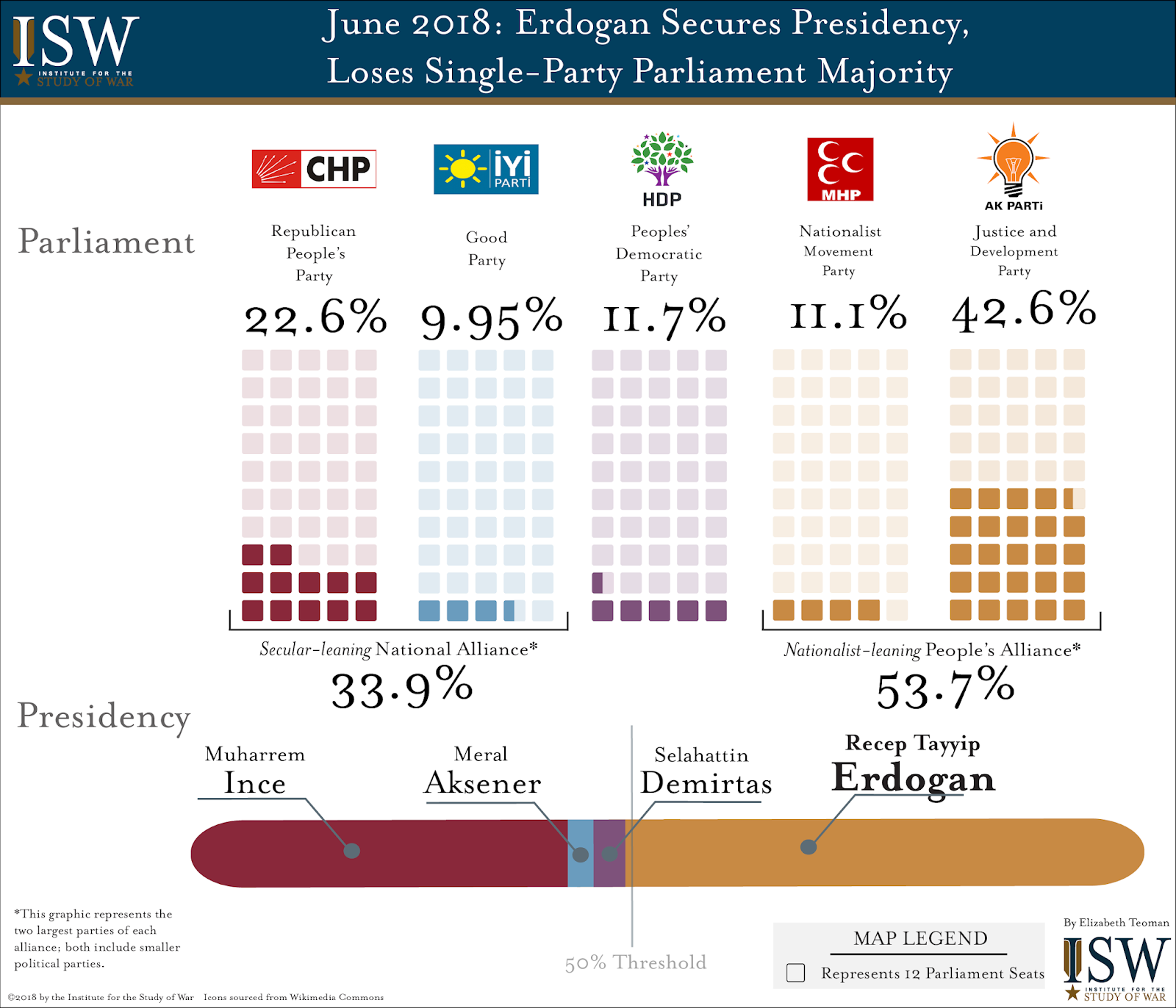
See the note below regarding the validity of the figures in this infographic.
Erdogan is now more dependent on his alliance with the main right-wing party and will likely confront Kurdish militants more forcefully. Erdogan’s ruling Justice and Development Party (AKP) lost its majority in the Turkish Parliament.[1] He nonetheless retained a parliamentary majority through his alliance with the right-wing Nationalist Movement Party (MHP). Erdogan must remain responsive to the MHP even though the new executive presidency sharply curbs the power of the legislature. The MHP takes an uncompromising stance in favor of a militarized approach to the Kurdistan Workers’ Party (PKK) and its affiliate in Syria.Erdogan will likely satisfy this domestic audience by making good on his promises of expanded operations against the PKK in Iraq and Syria. Erdogan’s campaign against PKK-affiliates partnered with the U.S. in Syria will serve to deepen the rift in the U.S.-Turkish alliance.
Infographic Note: This graphic presents interim election results sourced from Turkish state-run Anadolu Agency endorsed by the Supreme Electoral Council of Turkey. These results reflect a Turkish election that was neither fair nor free with electoral fraud likely.
[1] “Cumhurbaşkanı ve 27. Dönem Milletvekili Genel Seçimleri,” Anadolu Ajansi. June 25, 2018. https://secim(.)aa.com.tr/tr


