
Authors: Kelly Campa and Daniel Shats, with Karolina Hird and Frederick W. Kagan
Data cutoff: August 11, 2025
Key takeaways:
- The PRC and Russia may be providing the Iranian-backed Houthis with military equipment in exchange for safe passage through the Red Sea and as a way to undermine Western interests in the Middle East.
- Recent Ukrainian intelligence reports that Russia is supporting North Korea’s nuclear weapons delivery systems contrasts with Russia’s continued unwillingness to help Iran’s nuclear program directly, likely reflecting Russia’s greater reliance on North Korea in its war in Ukraine. Russia’s differential approach to requests for help with nuclear weapons programs likely also reflects the fact that North Korea already has nuclear weapons, whereas helping Iran obtain nuclear weapons capabilities would be a much more dramatic step.
- The US-brokered Armenia-Azerbaijan peace agreement will likely relegate Russia and Iran to the sidelines as powers in the South Caucasus, which may lead Russia and Iran to deepen diplomatic coordination as part of a broader strategy to counter Western, Turkish, or Israeli influence.
Defense and Military-Technical Cooperation
The PRC and Russia may be providing the Iranian-backed Houthis with military equipment in exchange for safe passage through the Red Sea. Anti-Houthi Yemeni media reported on August 6 that Yemeni “counterterrorism forces” intercepted a “major shipment” of military equipment from the PRC bound for Houthi recipients at the Port of Aden.[1] The shipment reportedly contained drones, radio equipment, advanced control units, and weapons parts. The ship had rerouted from the Houthi-controlled port of al Hudaydah following Israeli airstrikes on July 21.[2] The shipment is the latest of several batches of PRC-origin equipment that Yemeni authorities have intercepted en route to the Houthis. Past shipments have included hydrogen fuel cells, drone propellers, and other components.[3] A PRC firm also provided the Houthis with satellite intelligence.[4] Russia has also transferred aid to the Houthis, though Iran is the group’s primary backer. [5] US media and government officials have reported that Russia-based entities have transferred millions of dollars of weapons, dual-use components, and other commodities to the Houthis as of April 2025 and that Russia has also provided the Houthis with targeting intelligence.[6] It is unclear the extent to which this aid has been directed by the PRC and Russian governments, however.
PRC and Russian aid for the Houthis may be part of an agreement to secure safe passage for Russian and PRC ships through the Red Sea and a way to undermine US and Western interests in the Middle East. Bloomberg reported in March 2024 that PRC and Russian diplomats had reached an agreement with the Houthis in Oman to ensure that the Houthis would not target their ships.[7] The Houthis have attacked commercial vessels from various countries in the Red Sea since October 2023, forcing most Western shipping companies to take a much longer route around Africa instead, which has driven up shipping costs.[8] The New York Times reported on August 10 that 14 PRC car carrying ships in July, and a similar number in June, safely transited the Red Sea en route to Europe, despite the Houthis sinking two other cargo ships in early July.[9] The report said that continuing shipments through the Red Sea and Suez Canal saves PRC automakers hundreds of dollars per car compared to Japanese, Korean, and European automakers, which have had to redirect shipments around the southern tip of Africa. Some PRC ships, including those belonging to state-owned shipping giant COSCO, are still avoiding the Red Sea, however.[10]
PRC Ministry of Foreign Affairs spokesperson Lin Jian did not confirm or deny whether Beijing had made an agreement with the Houthis and instead reiterated the PRC’s opposition to attacks on civilian vessels.[11] Lin also said that “all parties concerned” should respect the sovereignty and territorial integrity of countries bordering the Red Sea in a thinly veiled criticism of US, UK, and Israeli airstrikes on Houthi targets in Yemen. PRC officials have repeatedly called on the Houthis to stop their attacks but have insisted that the Red Sea conflict must be addressed at its root, which they define as the Israeli-Palestinian conflict.[12] The PRC and Russia have provided diplomatic cover and legitimacy to the Houthis, with both countries abstaining from UN votes that condemned the Houthis in January and July 2025, and Russia inviting Houthi representatives to Moscow on several occasions.[13] Russian and PRC support for the Houthis is tempered by their continued relations with the internationally-recognized government of Yemen, however, and especially by their desire for good relations with Saudi Arabia and the United Arab Emirates, regional rivals of Iran that fought the Houthis in Yemen since 2015.[14]
Defense Industrial Base (DIB) Cooperation
Recent Ukrainian intelligence reports that Russia is supporting North Korea’s nuclear weapons delivery systems contrasts with Russia’s continued unwillingness to help Iran’s nuclear program directly, likely reflecting Russia’s greater reliance on North Korea in its war in Ukraine. Ukraine’s Main Military Intelligence Directorate (GUR) Head Kyrylo Budanov said on August 5 that Russia is helping North Korea modernize nuclear weapons delivery systems.[15] Budanov stated that Russia is unlikely to transfer technology for Iran’s nuclear weapons program, however, attributing the difference in part to the fact that North Korea already possesses nuclear weapons and Iran does not. A Financial Times investigation revealed on August 5 that an Iranian delegation of nuclear scientists and an intelligence officer visited Russia in August 2024 to seek cooperation with Russian companies and research institutes that produce dual-use technologies that could support Iran’s nuclear weapons program.[16] The scientists were affiliated with the Iranian Defense and Armed Forces Logistics Ministry (MODAFL)’s Organization of Defensive Innovation and Research (SPND), which played a leading role in the Iranian nuclear weapons research program before 2003. There is no indication that the scientists reached any agreement with their Russian interlocutors, however. ISW continues to assess that Russia does not support Iran developing a nuclear weapon, though it has argued in favor of Iran’s right to enrich uranium for civilian nuclear energy.[17] Russia has openly stated that it no longer opposes North Korea’s nuclear weapons program, by contrast, instead accepting nuclear weapons as essential to North Korea’s defense.[18]
Russia has become more dependent on North Korea and less dependent on Iran as the war in Ukraine has progressed. Russia imported and deployed thousands of Iranian-made Shahed attack drones in the first years of the Ukraine war, then signed a deal with Iran in early 2023 to produce the drones domestically in Russia.[19] CNN cited analysts and intelligence officials on August 8, 2025, who said that Russia has now localized 90 percent of production for the Shahed drones and upgraded their design, significantly reducing Russia’s dependence on Iran.[20] Russia’s Alabuga drone factory alone produces 5,500 Shahed drones per month, according to Ukrainian intelligence, at a much cheaper cost per drone than Russia had previously paid to Iran. Ukrainian intelligence also reported that Russia has begun exporting Shahed manufacturing capabilities to North Korea.[21] The Moscow-Tehran relationship has also been strained by Russia’s failure to meaningfully help Iran to defend itself, retaliate, or reconstitute following the June Israel-Iran war.[22] Russia’s relationship with North Korea has rapidly deepened, by contrast, as North Korea signed a mutual defense agreement with Russia in 2024, deployed around 12,000 troops to help repel a Ukrainian incursion into Russian territory, and now supplies Russia with nearly 40 percent of the ammunition it uses against Ukraine.[23] South Korean intelligence assessed that North Korea may deploy additional troops to Russia in August, while Ukrainian intelligence estimated that Pyongyang could send 25,000 to 30,000 more troops in the coming months.[24] Russia has repaid North Korea’s wartime support with significant economic and technological assistance, reportedly including the transfer of a Pantsir anti-air missile system, electronic warfare systems, ballistic missile data, and over a million barrels of oil.[25] Russia likely views North Korea as a more reliable partner than Iran at this time. North Korea is not at war and is unlikely to be attacked in the near future; its regional ambitions do not obviously conflict with Russian interests; it does not compete with Russia as an oil exporter; and it has demonstrated both a will and capacity to support Russia’s war effort in ways that Iran has not, including deploying troops to Russia. Russia also likely believes its aid to North Korea’s military and nuclear development will be less destabilizing from the standpoint of Russian interests than helping Iran, in part because it can exert more influence over North Korea than it can over Iran.
Economic and Financial Cooperation
Nothing significant to report.
Political and Diplomatic Cooperation
The US-brokered Armenia-Azerbaijan peace agreement will likely relegate Russia and Iran to the sidelines as powers in the South Caucasus. Azerbaijani President Ilham Aliyev and Armenian Prime Minister Nikol Pashinyan signed a joint peace declaration at the White House on August 8.[26] US President Donald Trump brokered the agreement, which states that Azerbaijan and Armenia will agree to a ceasefire and to give up all claims to the other state’s territory.[27] Neither Aliyev nor Pashinyan have signed the peace agreement yet and have claimed that both countries have further steps to take before the final agreement is signed.[28] Armenia notably announced that it will give the United States exclusive development rights to a 27-mile corridor through southern Armenia that connects Azerbaijan to its exclave, the Nakhchivan Autonomous Region.[29] The planned route will stretch along Armenia’s border with Iran and will reportedly include the construction of new railways, communication lines, oil, and gas pipelines.[30]
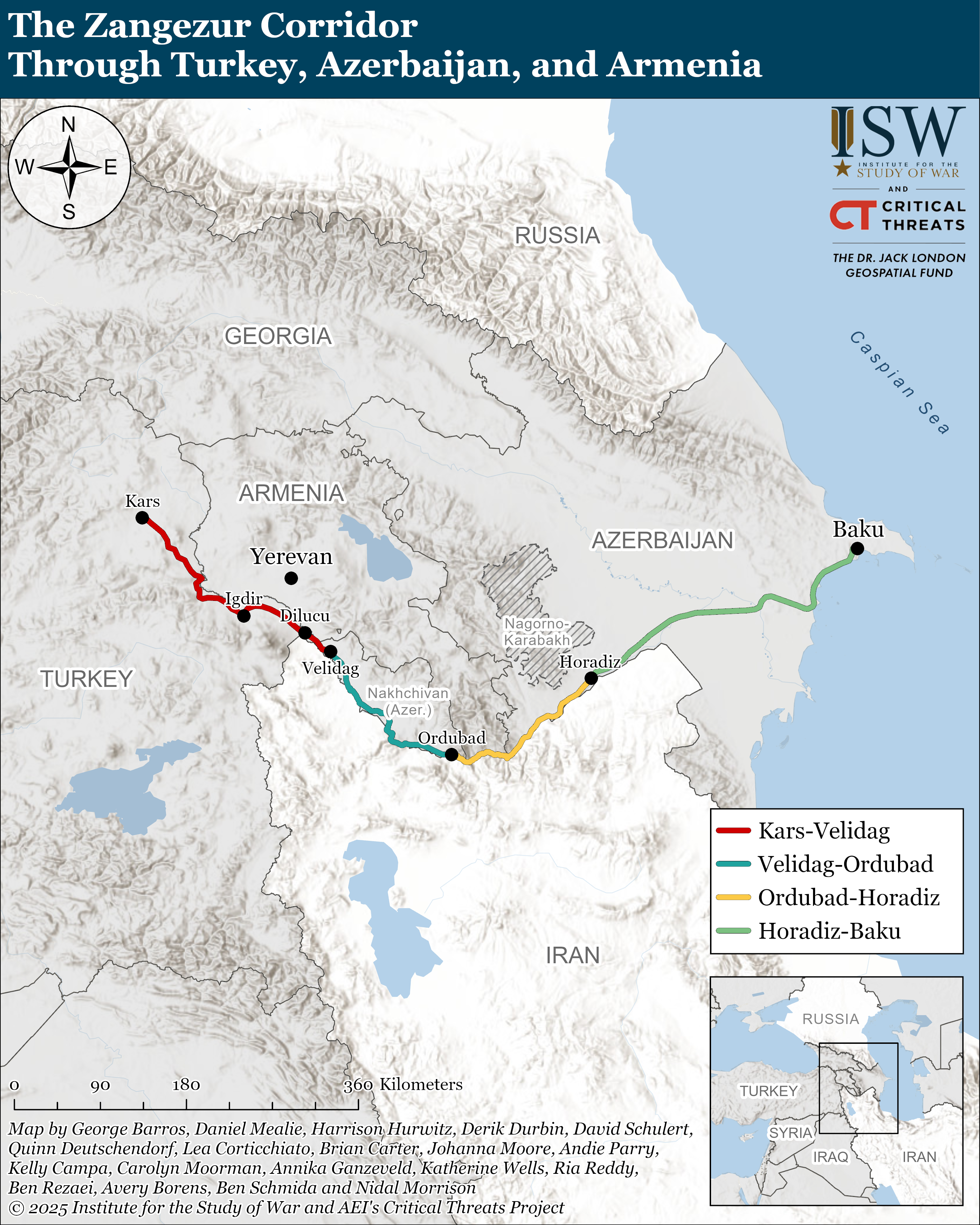
Iran views the establishment of an Azerbaijan-Nakhchivan corridor through Armenia as a significant threat to its economic and political interests in the South Caucasus. The agreed-upon corridor resembles the concept of the Zangezur Corridor—a proposed Turkish-Azerbaijani transit route that would connect Azerbaijan to Nakhchivan. Iranian policy in the South Caucasus has been premised on preventing the establishment of the Zangezur Corridor since Azerbaijan first proposed the corridor after the conclusion of the Second Nagorno-Karabakh War in 2020.[31] Iran has strained relations with Azerbaijan due to the latter’s ties to Israel and Turkey and views the corridor as an attempt to expand Turkish influence into Eurasia.[32] Iranian officials reacted strongly to the announcement of the Azerbaijan-Armenia agreement and the Azerbaijan-Nakhchivan corridor and threatened to forcefully respond to any US presence along the Iranian border.[33] Iranian Supreme Leader International Affairs Adviser Ali Akbar Velayati decried the corridor as “political treachery” and claimed that the passage would not become “a gateway for Trump’s mercenaries,” threatening that the corridor would instead become “their graveyard.”[34] Iranian Armed Forces General Staff-affiliated outlet Defa Press declared on August 12 that power dynamics in the South Caucasus are shifting in favor of the ”Washington-Ankara-Baku” axis.[35]
The US-brokered deal also notably sidelines Russia, which has historically dominated the South Caucasus as a major powerbroker. Russian Ministry Foreign Ministry spokesperson Maria Zakharova responded to the August 8 Trump-Aliyev-Pashinyan meeting and criticized Western interference in the South Caucasus, claiming that mediation should be limited to Russia, Iran, and Turkey as Armenia and Azerbaijan’s immediate neighbors.[36] Russia has historically sought to position itself as a mediator between Armenia and Azerbaijan, but the war in Ukraine has constrained Russia’s capabilities to project power and influence in the region. Russia’s previously close relationship with Armenia has suffered from notable setbacks in recent years, particularly since Russian peacekeepers failed to stop Azerbaijan’s takeover of the ethnically Armenian area of Nagorno-Karabakh in September 2023.[37] The new peace agreement will reportedly ban the presence third-party forces deployed along the Armenia-Azerbaijan border.[38] This ban presumably includes Russian forces, as Russia still maintains a military base in Armenia.[39]
Iran and Russia likely fear that the implementation of the US-developed corridor will expand US and Turkish regional influence and therefore undermine their political and economic interests in the South Caucasus. Iranian Foreign Minister Esmail Baghaei declared on August 11 that Iran will “in no way” accept any border “blockade” from Armenia.[40] The corridor would cut Iran’s prized land access to Russia and Europe through Armenia and would also introduce a new international transit route from which Iran is excluded. This would undercut Iran’s aspirations to establish itself as a major regional transit hub in order to support its economy and to reduce the impact of international sanctions. Azerbaijan has previously relied on routes through Iranian territory to reach Nakhchivan, to Iran’s economic and reputational benefit.[41] The construction of a new corridor that reduces Azerbaijan’s reliance on Iran to reach its exclave, therefore denies Iran access to Azerbaijan as a critical source of political leverage and revenue. The corridor also limits Iranian trade access while enabling a greater degree of Turkish trade access. Turkey currently relies on transit routes through Iran to trade with Central Asia. Turkey may be able to use the US-developed corridor and reach the Caspian Sea or possibly even India and the People’s Republic of China (PRC) while circumventing Iran completely. The new peace agreement may have less immediate impact on Russia’s economic relationships with both Armenia and Azerbaijan than it will on Iran’s given Russia’s well-established economic partnerships with Armenia and Azerbaijan. Russia has additionally supported the construction of the Zangezur Corridor since 2024.[42] Russia likely fears, however, that the US involvement in the development of oil and gas pipelines along the corridor may draw Armenia and Azerbaijan closer to the United States politically. Russia is likely particularly sensitive about this prospect given its recent geopolitical losses in Nagorno-Karabakh in 2023 and Syria in 2024, as well as due to Moscow’s continued efforts to assemble a coalition of states to counterbalance US influence.[43]
Azerbaijan’s deepening ties with Russia’s and Iran’s regional adversaries may compound Russian and Iranian fears that a deal that elevates Azerbaijan will undermine Russian and Iranian interests in the region. Azerbaijan has recently begun more explicitly aligning itself with Ukraine, for example. Azerbaijani President Aliyev notably encouraged Ukraine to “never accept [Russia’s] occupation” in a June 2025 speech.[44] Aliyev approved funds to allocate Azerbaijani electrical equipment to Ukraine on August 11, following Russian strikes on Azerbaijan-linked energy infrastructure in Ukraine.[45] Russia is therefore likely to view Azerbaijan’s pivot towards Ukraine and the United States in tandem as a threat to Russia and its war effort, particularly given its sensitivity over recent failures to support its partners and manage its global reputation.
Iran’s regional adversaries have also strengthened ties with Azerbaijan in recent months. Iran viewed Syrian President Ahmed al Shara’s July 2025 visit to Baku as a challenge to Iran’s position in the Southern Caucasus, particularly as the visit resulted in a deal to export Azerbaijani gas to Syria via Turkey.[46] Shara also met with Israeli officials during his visit, highlighting the importance of the Southern Caucasus as grounds for Iran-Israel competition.[47] The Armenia-Azerbaijan agreement complicates Iran’s ability to use the southern Caucasus as a platform from which to challenge Israel. Israeli government officials have shown increasing interest in building cooperation between Azerbaijan, Israel, and the United States and have called for including Azerbaijan in the Abraham Accords.[48] The Iranian regime has often accused Baku of allowing Israel to use Azerbaijani territory to launch operations against Iran, and the widespread view in Tehran that Azerbaijan supported or even facilitated Israeli operations against Iran during the recent 12-day war has worsened Iran and Azerbaijan’s historically strained relations.[49] Azerbaijan’s strengthening relations with regional Iranian adversaries, as well as its recent cooperation with the United States, have likely contributed to the growing fear in Tehran that Azerbaijan has become a platform through which Iranian adversaries can exert influence in the South Caucasus. This concern adds to the threat that Iran already sees from Baku, which is amplified by the future corridor. Iranian Armed Forces General Staff-affiliated outlet Defa Press warned on August 12 that Azerbaijan could use the Zangezur Corridor for military or intelligence purposes, for example.[50]
Russia and Iran may deepen diplomatic coordination in the South Caucasus, given their aligned interests in countering the expansion of US and Turkish influence. Differing Russian and Iranian interests in the South Caucasus have previously presented a source of tension between the two countries. Russia has historically supported the construction of the Zangezur Corridor, despite Iranian opposition to the project.[51] Iran has publicly supported Azerbaijan’s claims to Nagorno-Karabakh, whereas Russia helped mediate a ceasefire to the 2020 Nagorno-Karabakh War and deployed a peacekeeping mission to the region, to Armenia’s temporary benefit.[52] Velayati stated on August 9 that Iran will object to the Zangezur Corridor “with or without Russia’s help,” suggesting that Iran may anticipate that Russia will be uncooperative.[53]
Despite historical friction in the South Caucasus, both Russia and Iran share an interest in countering the growing role of Turkey and the United States in the region. Russia and Iran may intensify cooperation in the South Caucasus as both countries have done when their interests aligned to keep the Bashar al Assad regime in power during the Syrian Civil War and later to support Russia’s invasion of Ukraine. Any joint effort in the South Caucasus would likely include diplomatic coordination, which Iran has reportedly already attempted to initiate. An Iranian parliamentarian said on August 10 that Iran is planning to propose a trilateral meeting with the Russian and Turkish foreign ministers to discuss the “consequences” of the Zangezur Corridor, for example.[54]
Russia and Iran may attempt to deepen their existing relations with Armenia as part of a broader strategy to counter Western, Turkish, or Israeli influence in the South Caucasus. Both countries engaged Armenia following the August 8 agreement. Iranian President Masoud Pezeskhian warned Pashinyan during a phone call on August 11 to be wary of foreign attempts to use the agreement as a way to achieve “hegemonic goals,” likely referring to the United States.[55] Russian President Vladimir Putin also called Pashinyan on August 11 and noted that Russia is ready to facilitate peace between Armenia and Azerbaijan and participate in ”unblocking transport communications” in the region.[56] Several details about the implementation of the peace agreement have yet to be announced or decided, which affords both Armenia and Azerbaijan the opportunity to include Russia in some capacity in the corridor’s development in the future. Russia may attempt to pressure Armenia, Azerbaijan, or Turkey for its inclusion, although none of these states are likely to cater to Russian demands at this time.
The PRC is likely to be resistant to Russian or Iranian attempts to bring Beijing into diplomatic efforts to oppose the corridor and growing US and Turkish influence in the region. Russian State Duma International Affairs Committee First Deputy Head Alexei Chepa warned that US control of the corridor changes the balance of power in the South Caucasus in a manner that “greatly affect[s]” Iranian and PRC interests, in an apparent attempt to involve the PRC in discussions about the South Caucasus.[57] Defa Press called upon Iran to lean on its alliances with Russia and the PRC.[58] The PRC Foreign Ministry has not commented on the peace agreement as of this writing, but the agreement and corridor may benefit the PRC’s Trans-Caspian International Transport Route (TITR), which links the PRC to Europe through Azerbaijan, Georgia, and Turkey. Newly established railways through Armenia may allow the PRC to expand its trade along this route. The PRC also maintains a close relationship with Azerbaijan and recently upgraded its relations with Azerbaijan from a “strategic partnership” in 2024 to a “comprehensive strategic partnership” in May 2025.[59]

[1] https://www.4may dot net/news/147240 ; https://en.barran dot press/news/topic/6870 ; https://x.com/Alsakaniali/status/1953184788703011042 ; https://x.com/defenseliney/status/1953190887372276105
[2] https://www.reuters.com/world/middle-east/israeli-military-attacks-houthi-targets-yemens-hodeidah-port-2025-07-21/; https://understandingwar.org/backgrounder/iran-update-july-21-2025
[3] https://understandingwar.org/backgrounder/china-taiwan-weekly-update-march-27-2025
[4] https://understandingwar.org/backgrounder/iran-update-april-17-2025
[5] http://state.gov/sanctioning-iran-backed-houthi-network-procuring-weapons-and-commodities-from-russia ; https://www.wsj.com/world/russia-provided-targeting-data-for-houthi-assault-on-global-shipping-eabc2c2b
[6] http://state.gov/sanctioning-iran-backed-houthi-network-procuring-weapons-and-commodities-from-russia ; https://www.wsj.com/world/russia-provided-targeting-data-for-houthi-assault-on-global-shipping-eabc2c2b
[7] https://www.bloomberg.com/news/articles/2024-03-21/china-russia-reach-agreement-with-yemen-s-houthis-on-red-sea-ships
[8] https://www.nytimes.com/2025/08/11/business/china-electric-vehicles-red-sea.html
[9] https://www.nytimes.com/2025/08/11/business/china-electric-vehicles-red-sea.html
[10] https://www.nytimes.com/2025/08/11/business/china-electric-vehicles-red-sea.html
[11] https://www.fmprc.gov dot cn/fyrbt_673021/202508/t20250811_11688006.shtml
[12] https://www.chinadailyhk dot com/hk/article/615624
[13] https://www.usnews.com/news/politics/articles/2025-07-15/un-council-authorizes-continuing-vigilance-of-attacks-by-yemens-houthi-rebels-on-red-sea-shipping ; https://www.securitycouncilreport.org/whatsinblue/2025/01/houthi-red-sea-attacks-vote-on-a-draft-resolution-3.php ; https://home.treasury.gov/news/press-releases/sb0041
[14] https://www.cfr.org/global-conflict-tracker/conflict/war-yemen
[15] https://en.interfax.com dot ua/news/general/1093553.html
[16] https://www.ft.com/content/00f6f94c-d584-430c-b6d7-cc85933fc3e6
[17] https://understandingwar.org/backgrounder/adversary-entente-task-force-update-june-11-2025
[18] https://www.reuters.com/world/russias-lavrov-says-north-koreas-nuclear-status-is-closed-issue-2024-09-26/
[19] https://www.twz.com/news-features/what-does-a-shahed-136-really-cost ; https://edition.cnn.com/2025/08/08/europe/russia-drone-factory-iran-intl
[20] https://edition.cnn.com/2025/08/08/europe/russia-drone-factory-iran-intl
[21] https://understandingwar.org/backgrounder/adversary-entente-task-force-update-june-11-2025
[22] https://understandingwar.org/backgrounder/adversary-entente-task-force-update-july-2-2025
[23] https://www.bloomberg.com/news/articles/2025-07-11/ukraine-spy-chief-says-40-of-russian-ammunition-is-north-korean?embedded-checkout=true ; https://www.npr.org/2025/04/28/nx-s1-5379436/north-korea-russia-ukraine-troops-putin-kim
[24] https://www.reuters.com/business/aerospace-defense/north-korea-may-send-more-troops-russia-july-or-august-ukraine-war-seoul-says-2025-06-26/ ; https://archive.ph/eg8Nq
[25] http://newsweek.com/russia-north-korea-reward-troops-ukraine-msmt-2078520 ; https://www.nknews.org/pro/russian-oil-streams-into-north-koreas-main-port-amid-cooperation-in-ukraine/ ; https://www.reuters.com/business/energy/satellite-imagery-indicates-north-korea-oil-imports-russia-top-un-limits-report-2024-11-22/
[26] https://www.nytimes.com/2025/08/08/us/politics/trump-armenia-azerbaijan-peace-deal.html
[27] https://www.forbes.com/sites/melikkaylan/2025/08/10/the-armenia-azerbaijan-peace-deal-and-the-new-trump-corridor; https://www.reuters.com/world/azerbaijan-armenia-publish-text-us-brokered-peace-deal-2025-08-11
[28] https://www.reuters.com/world/azerbaijan-armenia-publish-text-us-brokered-peace-deal-2025-08-11
[29] https://www.nytimes.com/2025/08/08/us/politics/trump-armenia-azerbaijan-peace-deal.html
[30] https://www.forbes.com/sites/melikkaylan/2025/08/10/the-armenia-azerbaijan-peace-deal-and-the-new-trump-corridor/
[31] www dot news.am/eng/news/657195.html; https://understandingwar.org/backgrounder/iran-update-september-12-2024; https://understandingwar.org/backgrounder/adversary-entente-task-force-update-july-23-2025
[32] https://defapress dot ir/fa/news/762702; https://understandingwar.org/backgrounder/adversary-entente-task-force-update-july-23-2025
[33] https://www.tasnimnews dot com/en/news/2025/08/09/3372566/with-or-without-russia-iran-will-block-us-corridor-in-caucasus-velayati
[34] https://www.tasnimnews dot com/en/news/2025/08/09/3372566/with-or-without-russia-iran-will-block-us-corridor-in-caucasus-velayati
[35] https://defapress dot ir/fa/news/769404
[36] https://t.me/MID_Russia/63629
[37] https://understandingwar.org/backgrounder/russian-offensive-campaign-assessment-september-19-2023
[38] https://www.reuters.com/world/azerbaijan-armenia-publish-text-us-brokered-peace-deal-2025-08-11/
[39] https://www.themoscowtimes dot com/2025/03/20/in-armenias-second-city-russian-military-outpost-with-a-dark-past-faces-a-precarious-future-a88405
[40] https://www.iranintl.com/en/202508112173; https://www.tasnimnews dot com/fa/news/1404/05/20/3373708
[41] https://asiatimes.com/2023/10/iran-and-azerbaijan-begin-building-road-to-nakhchivan/
[42] https://understandingwar.org/backgrounder/iran-update-september-12-2024
[43] https://understandingwar.org/backgrounder/russian-offensive-campaign-assessment-september-19-2023; https://understandingwar.org/backgrounder/iran-update-december-15-2024
[44] https://www.kyivpost dot com/post/56666
[45] https://kyivindependent dot com/aliyev-sends-2-million-in-energy-aid-to-ukraine-after-russian-strikes-on-azerbaijani-linked-sites/
[46] https://www.iswresearch.org/2025/07/iran-update-july-16-2025.html
[47] https://english.alarabiya.net/News/middle-east/2025/07/13/syrian-israeli-officials-meet-in-baku-diplomatic-source-in-damascus-
[48] https://amwaj.media/en/article/iran-weighs-options-as-azerbaijan-aligns-closer-with-israel-us
[49] https://www.criticalthreats.org/analysis/iran-update-april-14-2023 ; https://www.criticalthreats.org/analysis/iran-update-november-30-2023-6569315598267; https://understandingwar.org/backgrounder/iran-update-may-20-2025
[50] https://defapress dot ir/fa/news/769404
[51] https://understandingwar.org/sites/default/files/The%20Russia-Iran%20Coalition%20Deepens%20013025.pdf
[52] https://understandingwar.org/backgrounder/erdogan-seeks-upend-kremlin-backed-status-quo-nagorno-karabakh
[53] https://www.tasnimnews dot com/en/news/2025/08/09/3372566/with-or-without-russia-iran-will-block-us-corridor-in-caucasus-velayati
[54] https://x.com/SaeedAzimi1772/status/1954199012522725598
[55] https://www.tasnimnews dot com/fa/news/1404/05/20/3373985
[56] http://kremlin dot ru/events/president/news/77754
[57] https://lenta dot ru/news/2025/08/11/v-rossii-otreagirovali-na-peredachu-zangezurskogo-koridora-ssha/ ; https://www dot pnp.ru/politics/stroitelstvo-mosta-trampa-v-armenii-mozhet-postavit-pod-ugrozu-proekt-sever-yug-schitayut-v-gosdume.html
[58] https://defapress dot ir/fa/news/769404
[59] https://jamestown.org/program/azerbaijan-and-the-peoples-republic-of-china-announce-comprehensive-strategic-partnership/


